

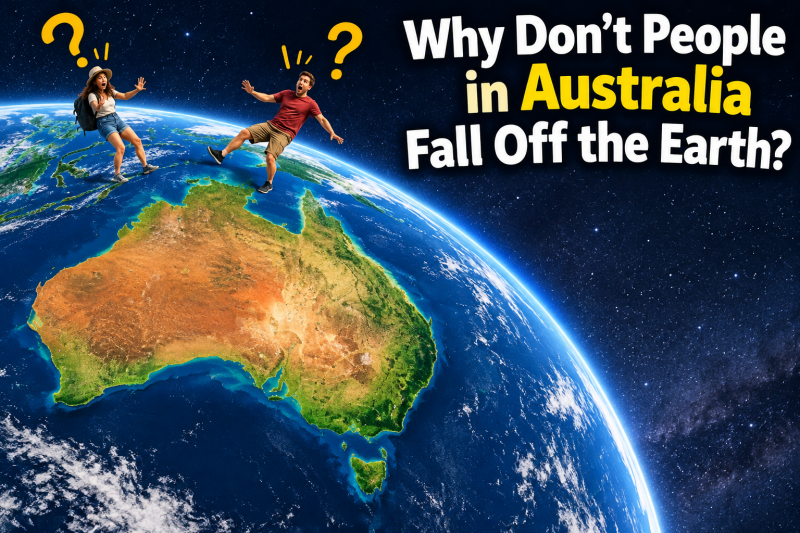
Why don't people in Australia fall off the Earth? It's a perfectly reasonable question when you consider that Australia sits near the bottom of most world maps and globes.
Look at a globe with Scotland at the top and Australia somewhere underneath. Surely Australians should be hanging upside down, desperately clinging to the pavement while their sandwiches fall into space?
Yet Australians seem remarkably unconcerned. They walk their dogs, play cricket and drink coffee without the slightest fear of falling into the universe.
They've even found time to give us some excellent musicians. AC/DC, Men at Work and countless other Australian performers have entertained audiences worldwide without any apparent difficulty remaining attached to their homeland.
So what's keeping them there?
The answer involves gravity, the shape of our planet and a rather misleading idea of what up and down actually mean.
Gravity Doesn't Care Which Way Is Up
The first thing to understand is that gravity doesn't pull everything towards the bottom of a map.
It pulls objects towards the Earth's centre.
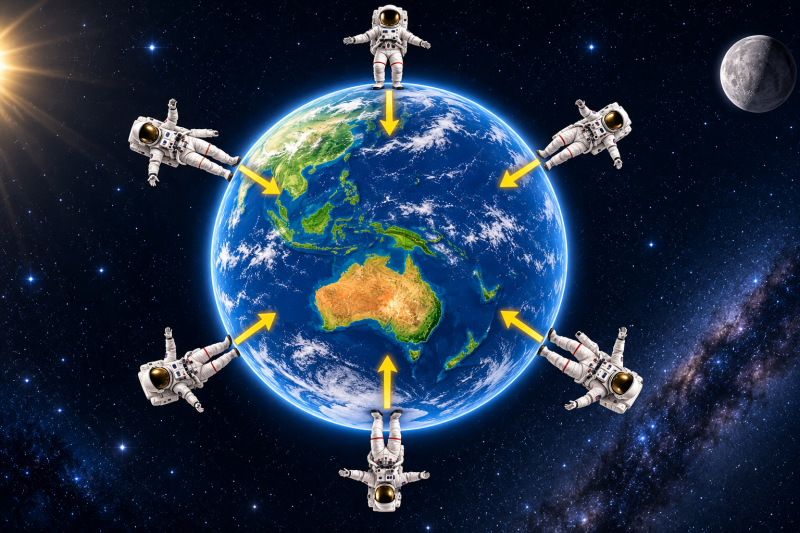
That's an important distinction because how Earth's gravity pulls everything towards its centre explains why Australians remain just as securely attached to the planet as everyone else.
Imagine the Earth as an enormous ball with people standing all around its surface.
Every person experiences a gravitational pull directed approximately towards the middle of that ball.
For someone standing in Scotland, that direction is down into the ground. For someone standing in Sydney, it's also down into the ground.
The directions are different when viewed from space, but the effect is essentially the same.
Nobody needs to cling to anything.
Gravity is already doing the heavy lifting.
Although, if gravity ever decided to take a holiday, perhaps we could all benefit from learning the fine art of doing absolutely nothing while floating helplessly into space.
If Australia Is Down Under Why Doesn't All the Water Flow There?
Now here's a question worth asking.
If Australia really is Down Under, shouldn't all the water in the world's oceans flow towards it?
Imagine the Atlantic, Pacific and Indian Oceans gradually draining southwards until Australia disappeared beneath one enormous puddle.
Fortunately for the Australians, gravity doesn't work like that.
Water is attracted towards the Earth's centre just as people and buildings are. Consequently, the oceans remain wrapped around our spherical planet rather than collecting at one imaginary bottom.
The sea surface settles into a shape governed by gravity, Earth's rotation and other influences.
There are tides, currents and differences in sea level, of course, but none of these results in the oceans emptying onto Australia.
Which is probably a relief to anyone living in Sydney.
Why Australians Don't Feel Upside Down
Now comes the interesting part.
If Australians are standing on the opposite side of the planet from us, shouldn't they feel upside down?
Not at all.
The explanation of why people on opposite sides of Earth stand upright comes down to their local sense of direction.
Your feet point towards the Earth's centre, while your head points away from it.
That's true whether you're standing in Edinburgh, Sydney or somewhere in between.
From your own perspective, you're standing perfectly upright.
For another perspective on this peculiar geographical puzzle, there's an exploration of why Australia is not upside down.
Two People and One Very Large Ball
Imagine two people standing on opposite sides of an enormous beach ball.
Both have their feet against its surface and their heads pointing outwards.
If they could see each other through the ball, each might insist that the other was upside down.
But neither would be correct in any universal sense.
They're simply standing in different directions relative to the ball's centre.
And that's exactly what's happening on
Why Do We Call Australia the Antipodes?
The British have another interesting name for Australia and New Zealand: the Antipodes.
The word comes from ancient Greek and essentially means having opposite feet.
It originally described people living on opposite sides of the Earth, whose feet would point in opposite directions when viewed from outside the planet.
Strictly speaking, Australia isn't directly opposite Britain. Much of Britain's true antipodal region lies in the South Pacific, with parts of New Zealand close to the opposite side of the globe.
Nevertheless, the name stuck.
And it makes a splendid description of a place where people apparently spend their lives standing the wrong way up.
At least, according to us.
Is There Really an Up and Down in Space?
Here's where our everyday understanding of direction starts to unravel.
On Earth, we use up and down constantly. We climb upstairs, drop things downwards and occasionally wonder why our trousers are falling down.
But why there is no absolute up or down in space is a question that challenges our familiar perspective.
Space doesn't come with a universal ceiling or floor.
There is no enormous arrow pointing upwards somewhere beyond the Moon.
Instead, our sense of vertical direction is largely determined by the gravitational field around us.
What Happens When We Leave Earth?
Imagine floating far away from planets, stars and other massive objects.
Without a nearby surface or strong gravitational reference, the familiar distinction between up and down becomes much less meaningful.
You could rotate yourself through 180 degrees and nothing fundamental about your position would change.
Of course, gravity still exists in space. Even astronauts orbiting Earth experience substantial gravitational attraction.
They float because they and their spacecraft are continuously falling around the planet together, not because gravity has disappeared.
Has the Globe Been Fooling Us?
There's another reason Australia looks as though it ought to fall off the planet.
Most maps and globes show north at the top.
We've become so accustomed to this arrangement that we unconsciously associate north with up and south with down.
But that's a convention, not a law of physics.
Understanding how Earth's spherical shape affects our sense of direction reveals why this familiar picture can be misleading.
Turn a globe upside down so Australia appears at the top.
Suddenly, Scotland is underneath.
Has anything physically changed?
Absolutely nothing.
The Earth hasn't moved, gravity hasn't reversed and Australians haven't developed a sudden superiority complex.
We've merely changed the way we're looking at it.
A south-up map is every bit as legitimate as a north-up map.
But Aren't There Still People Who Believe the Earth Is Flat?
Remarkably, yes.
Despite centuries of scientific evidence, there are still people who maintain that the Earth is flat.
Their explanations vary, but the fundamental problem remains: a flat Earth cannot satisfactorily explain the observations that demonstrate our planet's curvature.
Ships disappear hull-first over the horizon, Earth's shadow on the Moon during a lunar eclipse is curved, and people in different hemispheres observe different stars.
We also have satellite measurements, global navigation systems and photographs taken from space.
Perhaps most importantly for our Australian friends, the spherical Earth provides a coherent explanation for why gravity keeps everyone grounded, wherever they happen to live.
A flat-Earth model has rather more explaining to do.
For anyone who enjoys questions that sound ridiculous but lead to surprisingly sensible explanations, our Cookie Science pillar post gathers more investigations into the wonderfully absurd side of science.
A Little Australian Diversion: Why Do They Call Us Poms?
Since we've been discussing our Australian cousins, there's another question worth considering.
Why do Australians call British people Poms?
The nickname has been around for well over a century, although its precise origins remain uncertain.
One popular explanation claims that POM stood for Prisoner of Mother England, supposedly referring to convicts transported to Australia.
It's a colourful story, but there's little reliable historical evidence supporting it.
A more plausible explanation links Pom to pomegranate, possibly through rhyming slang associated with British immigrants.
Whatever its origins, the nickname became firmly established in Australian vocabulary.
And although it can occasionally be used disparagingly, it's often little more than affectionate teasing.
After all, we've been calling them Aussies for generations.
Of course, geographical differences are only one part of what makes people interesting. Our similarities and differences also raise fascinating questions about inheritance, as explored in this discussion of genetics and MS risk factors.
So Why Don't People in Australia Fall Off the Earth?
Because there is no universal bottom of the planet from which to fall.
Gravity holds people, oceans, buildings and everything else close to Earth's surface by pulling them towards its centre.
Australians aren't upside down. Neither are we.
We're all standing upright relative to our own patch of ground.
The only thing that's really upside down is our assumption that the top of a map must also be the top of the universe.
And perhaps that's the most delightful part of this ridiculous question.
Why Don't People in Australia Fall Off the Earth? Because gravity doesn't read maps.
Which is probably just as well. Imagine the paperwork if it did.
And if the Australians ever do find themselves falling into space, at least AC/DC could provide a tune or two.

Create Your Own Website With Webador