

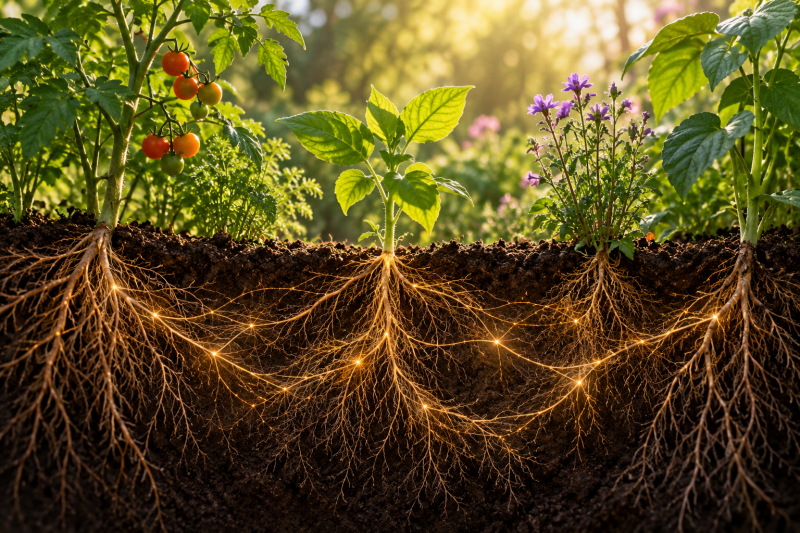
Imagine moving into a new house and discovering that your neighbours are constantly watching you. They know when you arrive, notice when you get too close and might even recognise members of their own family.
Now imagine that your neighbours are cabbages.
Can a Plant Recognise Its Neighbours, or is this another case of humans imagining intelligence where none exists?
Surprisingly, scientific research suggests that some plants distinguish between neighbouring plants and respond differently depending on whether those neighbours are relatives or strangers.
Before accusing the garden hedge of spying, however, we should understand what plant recognition actually means. That's the sort of unlikely question we enjoy exploring in our Cookie Science collection of curious questions.
Do Plants Really Know Who Lives Next Door?
Plants don't have eyes, ears or brains. They cannot look across the flowerbed and recognise Auntie Daffodil.
Nevertheless, plants are remarkably sensitive to their surroundings.
They detect changes in light, moisture, nutrients and chemicals released by other organisms.
Scientists have investigated how plants distinguish between relatives and unrelated neighbours, finding that some species behave differently when growing alongside close relatives.
Apparently, family relationships matter even when nobody has a family photograph.
How Do Plants Recognise Their Relatives?
One intriguing area of research concerns kin recognition, the ability to distinguish relatives from unrelated individuals.
Studies involving sea rocket plants suggest that individuals growing alongside unrelated plants develop more competitive root systems than those sharing space with relatives. A scientific review of kin recognition in plants explores the evidence for such responses and the questions researchers are still investigating.
This behaviour isn't universal, and scientists continue investigating the mechanisms involved.
It is rather like sharing a house with your brother instead of a stranger.
You might still argue over the bathroom, but perhaps you're less inclined to build a wall down the middle.
The Underground Conversation Between Roots
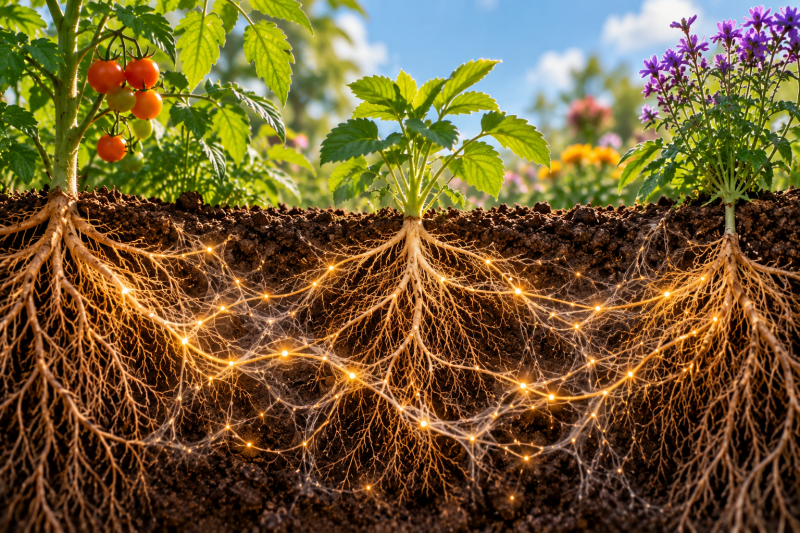
Above ground, a garden appears peaceful. Beneath the soil, however, roots continually explore their surroundings.
Chemical Messages Beneath the Soil
Researchers are investigating chemical signals exchanged between neighbouring plants, including substances released through their roots.
These substances, called root exudates, influence soil microorganisms and neighbouring plant growth.
Understanding how root systems detect nearby plants and respond to competition is another important part of the story.
Roots can change their growth when competing for water and nutrients, although detecting competition isn't necessarily the same as recognising a competitor.
The Wood Wide Web
The underground story becomes even more fascinating when fungi enter the picture.
The expression Wood Wide Web, popularised by the scientific journal Nature in 1997, describes networks of mycorrhizal fungi associated with plant roots. The name borrows from the language of the internet, whose own development is explored in the evolution of HTML.
These fungal networks can connect different plants, allowing certain nutrients and carbon compounds to move between them.
But the Wood Wide Web isn't simply an interconnected system of tree roots. It consists of fungal structures interacting with those roots.
Nor does resource transfer necessarily mean that trees deliberately share food or send warnings to their friends.
Nevertheless, the existence of these underground connections raises intriguing questions about how plant communities function.
Can Plants Recognise Neighbours Above Ground?
Plants also detect changes in the quality and direction of light.
Leaves absorb red light while reflecting or transmitting more far-red light. Nearby vegetation therefore changes the light reaching a plant.
Light-sensitive proteins called phytochromes detect these differences.
This demonstrates the role of light and environmental cues in plant recognition, although detecting vegetation doesn't mean identifying an individual plant.
Some species respond by growing taller to compete for sunlight.
It's the botanical equivalent of standing on tiptoe because somebody taller has arrived in front of you.
Are Plant Communities Collectively Intelligent?
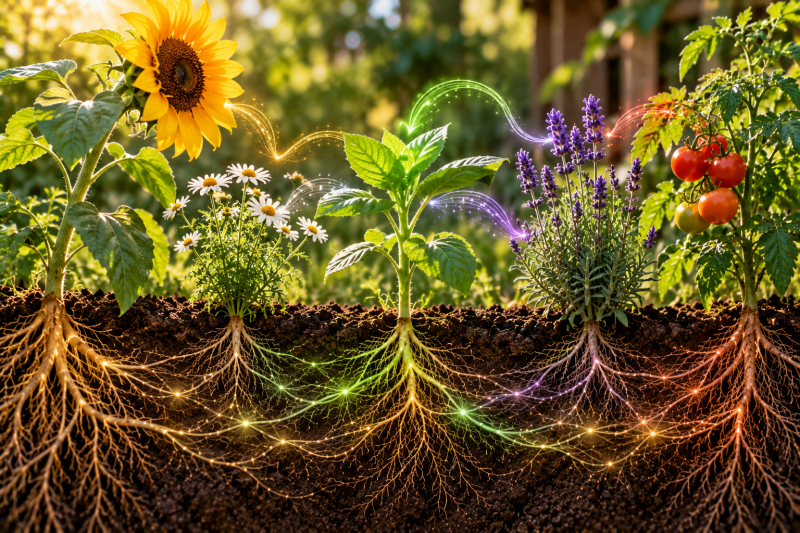
Plants aren't generally considered sentient organisms, but their coordinated responses can produce surprisingly complex patterns.
I would suggest that certain plant communities behave in ways resembling collective intelligence, even without individual members possessing conscious awareness.
The distinction is important. Complex group behaviour can emerge from simple biological interactions without anyone directing proceedings.
Nature offers some extraordinary examples of interconnected organisms.
The enormous fungal colonies nicknamed the Humongous Fungus and the extensive seagrass clones of Posidonia australis are contenders for records involving the largest living organisms, depending on how size is measured.
Neither example proves plant intelligence, but both challenge our everyday assumptions about what constitutes an individual organism.
The natural world never ceases to amaze me.
Does Talking to Plants Actually Help Them Grow?
King Charles, when he was Prince Charles, became famous for talking to his plants.
Perhaps that isn't quite as ridiculous as it sounds.
Many gardeners believe that talking to houseplants encourages healthy growth.
One suggested explanation involves the carbon dioxide we exhale, which plants use during photosynthesis.
However, ordinary conversation provides no established growth benefit, and any effect from exhaled carbon dioxide would depend on the circumstances.
Plants also respond to certain vibrations, although this doesn't demonstrate that they understand speech. Whether they would appreciate a heavy-metal soundtrack is another matter; for a human perspective on musical enjoyment, there's Music Hath Charms, Even When It's Heavy Metal.
During photosynthesis, plants absorb carbon dioxide and release oxygen. This process helps explain why forests are so important to Earth's ecosystems.
But describing rainforests as the planet's lungs is an imperfect analogy. Forests also consume oxygen through respiration, while marine photosynthetic organisms make substantial contributions to global oxygen production.
Conclusion: The Neighbours Are Watching — Sort Of
So, can a plant recognise its neighbours?
In certain circumstances, yes, provided recognition means detecting and responding differently to nearby organisms rather than consciously identifying them.
From kin recognition to fungal networks and environmental signals, plants reveal an extraordinary capacity to respond to their surroundings.
Perhaps the most intriguing possibility isn't that individual plants possess intelligence, but that complex behaviour can emerge from entire biological communities.
Cookie Science's final thought: Your neighbours might complain if you plant a hedge between your gardens. The hedge, meanwhile, could be busy assessing its own neighbours. And if the idea of plants knowing which way their neighbours are growing makes you wonder about directions, try why people in Australia don't fall off the Earth.
Create Your Own Website With Webador